F. P. Ricci was born to a prosperous merchant family on May 17, 1732, in the Italian city of Como, located on the border of the Swiss Alps. Upon completion of a liberal education, Ricci studied music and violin with Giuseppe Vignati, the Maestro di Cappella for the Ducal Palace of Milan. A historian of Como, G. B. Giovio (1748–1814) wrote that “The pupil had taste and grace,” whereas the teacher emphasized “profundity and the science of his art.”1 While Ricci was studying with Vignati in Milan, Giovanni Battista Sammartini and a group of composers, beginning in the 1740s, were presenting many outdoor orchestral concerts for the entire populace of Milan. According to Shulamith Brouwer, it was likely that Ricci attended these concerts and “watched the coming of age of the symphony from nearby.”2 Is it possible that as a young violin student he sometimes played in the orchestra?
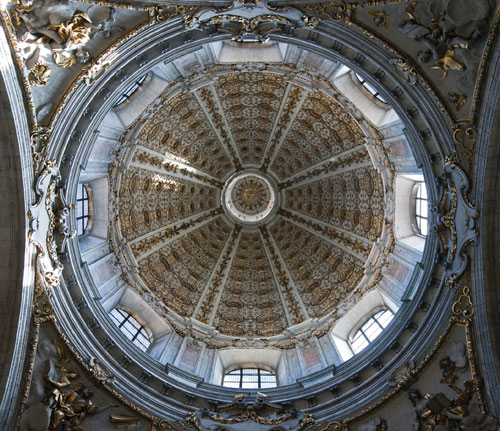
Ricci was ordained a priest in 1758, and on March 28, 1759, at the age of 27, he became Maestro di Cappella and organist for the Cathedral of Como. The Italian musicologist Oscar Tajetti writes that during this time Ricci “was also employed in Milan as director of a Musical Academy (a sort of association bringing together professionals and music-loving amateurs, with the shared goal of preparing and giving performances).”3
About 1764 Ricci made the journey across the Alps into the countries of Northern Europe, including Austria, Germany, France, England, and especially the Netherlands. He played violin, organ, psalterium, and harpsichord, and he also sang. Ricci was granted leave from the Como Cathedral, yet during the years of his absence he was able to keep his position as Maestro di Cappella. He gave concerts with the famous cellist Francesco Zappa. Ricci was a congenial companion, as one can see by Zappa’s letter to him of 1771: “We’ll make a nice trip, earn money, and we’ll have a very good time, like true friends, like brothers.”4
These tours mark the beginning of Ricci’s life at The Hague, where, except for a few trips back to Italy, he lived until 1780. Here, the musical scene was filled with activity and opportunity. The Stadtholder William V and his family were avid musicians. Evening chamber music was a regular event. There was a permanent court orchestra of about eight musicians who played in the many concerts and parties of the royal family. On important occasions, Ricci played the violin with the orchestra as a “private musician.”5
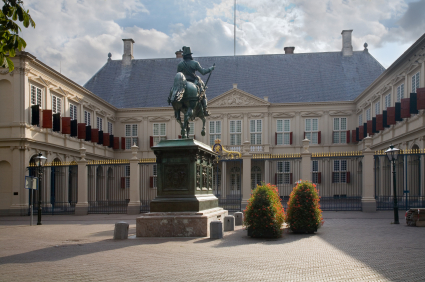 On Sundays, William’s sister Princess Caroline would invite famous touring musicians to play at the Oude Hoff palace. (In the photograph on the left.) Leopold Mozart made lists of all the people who attended young Wolfgang’s performances, and at one such event in 1765 the name “Mr. Ricci di Commo” appears near a “Mdlle Voshol,” the title of Josina van Aerssen’s baronage. Her name being close to Ricci’s on the list might be an early sign that she was already his student.6 Their friendship and her reverence for F. P. Ricci would last for many years into the future.
In 1768, when she was 35, Josina van Aerssen married Carel van Boetzelaer, who would later become a hero of the Dutch Republic. He was also the National Grandmaster of the order of Freemasons from 1759 to 1797. According to Helen Metzelaar, Ricci dedicated his Tre Sinfonie con Oboe e Trombe Obligate in 1765 to him.7
The Hague was at the center of the music publishing business. Almost as soon as Ricci moved there he became well-known, and important to his legacy as a composer, began to publish his works. The aforementioned Tre Sinfonie was possibly his first publication. Others followed:
- Opus 2, Six Symphonies for two Violins, Viola, two Oboes, two horns and Continuo. Published ca. 1765 by Hummel in Amsterdam.
- Opus 3, Six Trios for two Violins and Cello Obligato, ca. 1765,
The Hague.8 - Opus 4. F. P. Ricci’s entrepreneurial abilities were becoming evident with his publication of Six Sonatas for Harpsichord, Violin and Cello, published in London by Welcker and in The Hague, ca. 1768. With the help of the book dealer Lefebure, Ricci organized a subscription list of 211 people. The first part of the list consisted of nobility in Northern Europe. The people who followed were music lovers such as the famous music historian Dr. Charles Burney. “Mlle La Baronne d’Aarsen” was the first name on this alphabetical list.9
- Dies Irae, the work that would bring Ricci international fame as far as England and the New World,10 came out ca. 1773 with the signatures “A Stechwey” (the engraver) and “F. P. Ricci A 65” on the last page.11
In 1779 Ricci published his Recueil de Connaissances Elementaires pour le Forte-piano (Collection of Elementary Knowledge for the Forte-piano).12
Josina van Boetzelaer was one of F. P. Ricci’s most serious students. Not only did he introduce her to the art of creating music, he helped her to publish, and then, in addition, he sold her compositions throughout Europe. Probably because of Ricci’s skill as her manager, Josina van Boetzelaer became one of only two Dutch female composers of the eighteenth century whose music survives today.13 On his publication of “Sei Ariette a due Voci e Basso di varj Autori,” Ricci inscribed to Josina,
Most honored Lady,
Like a pilgrim who has climbed a high mountain, turns and looks happily at the deep valleys behind him: so you Honored Lady, having reached the point that you can rival the most famous singers and most excellent composers, can reread these pages which were your first endeavors in the past…
Your, Honored Lady, Most humble and obedient servant
and master, F. P. Ricci.14

Ricci served as a bridge over the Alps between Holland and Italy, connecting his Dutch students to Italian music and literature. His ability to combine the countries can best be seen in Josina van Boetzelaer’s dedications at the beginning of her four published works. She writes them in Italian and each one is inscribed to an Italian person introduced by Ricci. The finest example is the one she wrote to Pietro Metastasio, for her Opus 4, Arie Sciolte e Coro con Sinfonia. Ricci had visited the great Italian poet in Vienna and had performed van Boetzelaer’s compositions for him during a musical afternoon.15
The executive Ricci was dynamic. His business activities followed his concert tours, which were all over Europe. The Como State Archive shows that he was actively involved in selling his own music and also the compositions of other composers such as J. Ch. Bach, Cramer, Boccherini, and on many occasions, Josina van Boetzelaer.16
By 1778, Ricci achieved the level of a Fourth Degree Mason in “Le Veritable Zele” lodge of The Hague. Many of the members of this lodge were musicians and publishers. His certificate was signed by Josina’s husband and fellow member Charles baron De Boetzelaer, who mentioned, “his excellent personal qualities and distinguished talents.”17 Ricci’s name was listed with his title, Maitre de Chapelle de Cathedrale de Como.
Just when it seemed as though he was a fully participating citizen in the Dutch Republic, authorities at the Cathedral of Como summoned Ricci back to his post as Maestro di Cappella. Had he not returned, he would have lost the position. Ricci was forty-eight at the time. In Italy, he continued to dedicate himself to composing and performing, but from this time, sacred music would become his primary focus. He not only played organ and directed the choir at the Cathedral of Como, but he also participated in the musical activities at other nearby cathedrals. According to Oscar Tajetti, “at the Sanctuary of the Crucifix…he organized the ‘Fridays in March’ with oratorios and cantatas, a tradition which lasted even after his death.”18
In 1808 there was a big celebration in Como of the new organ that had just been built there by Serassi, according to Ennio Cominetti, “at the Basilica dell’ Annunziata…with the professors and amateurs performing selected pieces composed and directed by the celebrated conductor Abbot Ricci.”19 By this time, Ricci was 76 years old. He was still famous, and was continuing to write religious music. A Te Deum of his was performed on March 10, 1816, during the visit of Emperor Francis I.20 According to Oscar Tajetti, Napoleon requested (possibly through their mutual friend, the violinist Ostinelli) that Ricci write a funeral march. Ricci replied that he was too old.21
Ricci spent the last years of his life on family property at Loveno di Menaggio, near Lake Como. He died at Saint Anne’s hospital on November 7, 1817, and he left all his belongings to the hospital. Unfortunately many of his manuscripts have been lost, but let us hope that this music will eventually be retrieved.22
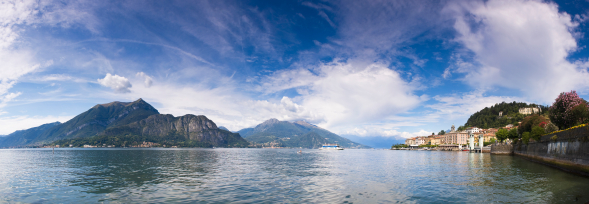
Oscar Tajetti informed me that no portraits of Ricci have as yet been found except the one of him done at Saint Anne’s Hospital after he died. (Above: Lake Como near Bellagio where Ricci spent his last years.)23]
Throughout the centuries, Francesco Pasquale Ricci has served as a uniting force between the Netherlands and Italy. This was seen in van Boetzelaer’s dedications at the beginning of her published works. In the present age, several centuries later, he is bringing these countries together once again with the endeavor of the Italian musicologist Oscar Tajetti, to inform the Dutch author Helen Metzelaar of Josina van Boetzelaer’s letters to Ricci in the Como State Archives. My deepest gratitude goes out to both of them for sharing their profound knowledge of a musician and teacher whose compositions can inspire us today as they did in his own time.
See “The Recueil and Its Transformations”
NOTES:
1. Oscar Tajetti (President, Antiquae Musicae Italicae Studiosi, Lombardi), “Francesco Pasquale Ricci: A Portrait,” 14–16, liner notes for the CD Sacred Works, Vol. 2, Nuova Era (No. 7244). Translated by D. Tabbet.
2. Shulamith Brouwer, from liner notes for the CD Francesco Pasquale Ricci—Six Sinfonias Opus Two, Etcetra (No. KTC1342). Translated by Carol Stennes.
3. Oscar Tajetti, “Francesco Pasquale Ricci: A Portrait,” p. 14.
4. Jacopo Franzoni, http://www.francescozappa.it/en/who-is-francesco-zappa.html (last accessed July, 20, 2010).
5. Helen Metzelaar, From Private to Public Spheres: Exploring Women’s Role in Dutch Musical Life from c. 1700 to c. 1800 and Three Case Studies (Chapter 3, Josina van Boetzelaer née van Aerssen, 119). Publisher: Koninklijke Vereniging voor Nederlandse Muziekgeschiedenis, 1999.
6. Ibid., pp. 112–113.
7. Ibid., pp. 114, 115, 120.
8. Sergio Martinotti, “Ricci, Francesco Pasquale,” Dizionario Della Musica e del Musicisti, Vol VI, Le Biographi, 325. Translated by Gabriella Einaga.
9. H. Metzelaar, From Private to Public Spheres, p. 120.
10. O. Tajetti, “Francisco Pasquale Ricci: A Portrait,” p. 15.
11. Huis Amerongen: Muziek Bibliotheek (Utrecht Archive), No. 1183. The first F. P. Ricci piece listed in the library, “45,” is the Recueil de Connaissances Elementaires pour le Forte-piano.
12. Helen Metzelaar, “Mon cher ami. A New Source on Francesco Pasquale Ricci (1732–1817), his Music Career, and his Dutch Pupils.” Tijdschrift van de Koninklijke Vereniging voor Nederlandse Muziekgeschiedenis LX (2010), p. 116, footnote 91.
13. H. Metzelaar, From Private to Public Spheres, p. 128.
14. Ibid., p. 121.
15. Ibid., p. 142.
16. H. Metzelaar, “Mon cher ami,” pp. 115–119.
17. Malcolm Davies, The Masonic Muse. Publisher: Koninklijke Vereniging voor Nederlandse Muziekgeschiedenis, 2005, p. 263.
18. Oscar Tajetti, “Francesco Pasquale Ricci and Como, a ‘European city.’ ” Meeting and concert on Saturday, April 19, 2008, Paolo Giovio Archeological Museum. Translated by Gabriella Einaga.
19. Ennio Cominetti, “Presentazione” J. Ch. Bach e F. P. Ricci, Metodo per il Forte-piano o Clavicembalo. Publisher: Paideia Editrice, Brescia, 1986. Taken from a facsimile of the 1786 LeDuc edition in which many mistakes were made in attempting to copy F. P. Ricci’s 1779 publication of the Recueil. Translated by Gabriella Einaga.
20. Sergio Martinotti, “Ricci, Francesco Pasquale,” Dizionario della Musica…, p. 325. Translated by Gabriella Einaga.
21. O. Tajetti, personal communication, November 16, 2010. Translated by Gabriella Einaga.
22. O. Tajetti, “Francesco Pasquale Ricci: A Portrait,” p. 15
23. O. Tajetti, personal communication, September 14, 2010. Translated by Gabriella Einaga. Professor Tajetti kindly sent me with his letter a copy of the only known portrait of Ricci which is at the Ospedale S. Anna, Como, Italy.